Author: P Antonio Rivero LC
I. INTRODUCTION
The Gospel of John is different from the rest of the Gospels. His vision of Jesus, their mysterious language, the focus of the work: everything makes him a unique Gospel. It has been said of him that is a gospel spiritual, and it certainly is. But while the Gospel is more emphasis on the Incarnation of Jesus and in the human details of his life. Embodiment of divinity and thus appear as two sides of the same mystery. II. DOCTRINAL OBJECTIVE: get into the Gospel of John.
III. LIVING OBJECTIVE: Assimilate the message that this Gospel has to offer.
IV. THESIS:
The Gospel of John is a response to the situation in their community and contains a deep reflection about the mystery of Jesus. Those who are with him and accept it, are gradually discovering the depth of this mystery, through faith. And those who reject, for lack of faith, end in the dark and blindness of sin. All signs and wonders are designed to discover a facet of the unfathomable riches of Jesus. And the speeches that follow miracles have a theological character, that is, reflect on Jesus and his mission. To John he is painted with an eagle, the eagle is the bird that gets more height, like the Gospel of John, who rose to the secrets of the Divine.
V. EXPLANATION OF THE THESIS:
- 1. Author, date and target
- The author is John the beloved disciple of Jesus. His mother, Salome is the group of women who followed Jesus to serve and is present at Calvary. John is always shown on the list after Pedro and three intimate of Jesus.
Christians who were directed by Juan lived a difficult and complex situation: b)
Externally, there was rejection and persecution. His pursuers are the Jews that appear on every page of his Gospel and expelled from the synagogue to the Christian community. Therefore, these Christians lived in fear, some were afraid to appear as disciples, others had left the community. And the main temptation to those still in the world was shut away in the upper room, retreat to the circle in which they were protected.
Therefore, this community has rallied around the "beloved disciple" John.

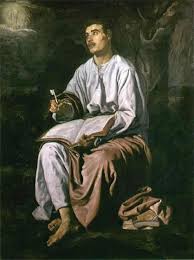 is a gospel very different from the other three. It has its own sources, so write 'his' gospel based on their memories and with a different purpose. Selected some miracles and deepened in its symbolic meaning, depending on what I wanted to teach the Christian community.
 speeches is rich and has a way of talking deep, reflective, abstract at times. John seems a theologian. So his language is adult faith. Talk with the new concepts used in the Hellenistic culture: light-dark, life, love, logos ... and adapts to the Christian faith. Part of realities: water, bread, birth, life, light ... but then transforms and transports us to other realities than through the
symbol. John uses much dialogue Nicodemus Jesus, Samaritan, Jesus, Jews, Jesus, born blind, Jesus, etc. to present their teaching in a more lively and participatory. Another
John is the following: presenting sign or miracle, and then makes the discourse on the sign.
3. Division and thematic content
John is the following: presenting sign or miracle, and then makes the discourse on the sign.
3. Division and thematic content
The Gospel is presented separately in two major sections, preceded by a prologue and followed by an epilogue:
a)
Prologue and testimonies (1, 1-51): anticipates large themes of the gospel, the Word, Life, Light, Truth, the world, the darkness ... and with it, the first evidence, presented to John as the last great prophet who points to Jesus as the Messiah.
b)
The Book of Signs
(2-12): narrated seven miracles and signs. What matters is not the miracle itself, but to reveal Jesus as He came again, as New Man, as light, as living water, such as Easter, etc.
c)
The book of the Passion and Easter (13-20). It has two sections: the farewell speech (13-17) and the passion and glory (18-21).
d) Epilogue
(21, 1-25): Meets various appearances of Jesus, in which the beloved disciple has an important place with Peter.
4. Content theological and spiritual
End of the Gospel of John: John wants to prove that Jesus is true God. Hence, his specialty being the theological discourses. Key:
The Gospel of John is a response to the situation in their community. A controversy over the divinity and humanity of Jesus, the evangelist responds deepening the mystery of his incarnation and death. And the temptation to flee the world, encourages pupils to consolidate their faith in Jesus, and united to him, leaving the world to bear witness to the truth. Before Jesus must decide: either to accept Jesus or rejects it. Those who meet Jesus and accept it will gradually discover the depth of this mystery: he is recognized as Lord, Prophet, Messiah and Savior of the world, and above all, as the Son of God. And those who do not agree, still in darkness, the blindness of their heart.
The more a Christian makes his decision for Jesus, for His Life, His truth, His righteousness ... so much more will face opposition from some who will make life impossible, to take his life.
Content:
a)
is called the spiritual Gospel
the mature Christian: long speeches meditative, preparation of items (bread of life, water, spirit and truth ...). These speeches are not so much words of Jesus but
speeches about Jesus
. Presents Jesus as the Word, Life, Light, Bread of Life, The Way, Truth, Life, Resurrection ...
b)
is the Gospel of signs: These signs are intended to awaken faith. He wants to prove that those signs or sacraments are an extension of those saving acts of Jesus. These are the signs:
water-baptism.
breads: the Eucharist.
water and blood from the side: baptism and the Eucharist.
blindness: the man who has found Christ-Light.
The hostility of the enemies of Jesus: the man who will not accept Jesus.
c)
is the Gospel of life and love
: all converge on Jesus' moral commandment of fraternal love. d)
is the Gospel of Jesus
hour: the hour of final victory, his glorification through free and voluntary surrender to the cross. It is time dear Jesus, as the supreme act of love. The Cross becomes the glorious throne from which Jesus founded the Church. And Mary is Mother of the Church made up fresh from the side of Christ. The intimacy established between the mother and the beloved disciple symbolize the relations that should exist between the Church and their children. e)
is the Gospel of the Father
: the life of Jesus by John as an out of the Father, stay true to the mission the Father entrusted to her, and return to the Father to be glorified and sat on his right.
The theme of Christ-Life is truly the heart of the Gospel of John, all other issues are related to this: "I I am the light ... living water ... the bread of life. "
CONCLUSION:
The Gospel of John is, in fact, a doctrinal letter as gospel. His first intention is not to narrate, but to teach. The main interest of this work is of a theological miracles are there signs, the speeches, more speeches of Jesus are speeches about Jesus. Such speeches are not about the problems of the time of Jesus (the law, the Sabbath, pure or impure food, etc ...) but on the mission of Jesus in the world: to be the Messiah, sent by the Father, Light world, living water, bread of heaven.
PRAYER:
Lord, if You are the Word, tell us. If you are the Light, enlighten us. If you are Life, vivifícanos. If you are the truth, teach. If You are the Way, lead us to the Father. If you are the Resurrection, resucítanos. If you are the living bread, feed us. If You are the Living Water, sácianos. If you are the Shepherd, guide us with your pastures of salvation. If You are the New Man, men make us new to us. If you are the New Wine, intoxicate. Amen. QUESTIONNAIRE 1. How has San Juan Jesus? 2. Unlike the other Gospels, John's What gives greater importance: the preaching of Jesus through the parables, or the speeches in which Jesus proclaims its identity, its mission and its relationship with the Father?

0 comments:
Post a Comment